Bench Standard for American Foxhounds
Provided Courtesy of the National Foxhunters Association
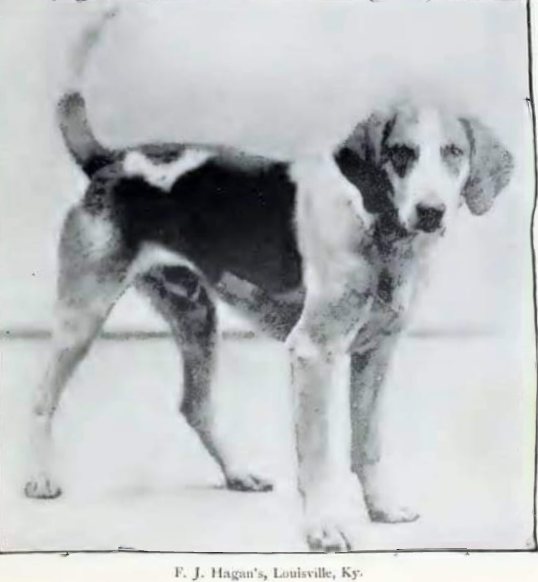
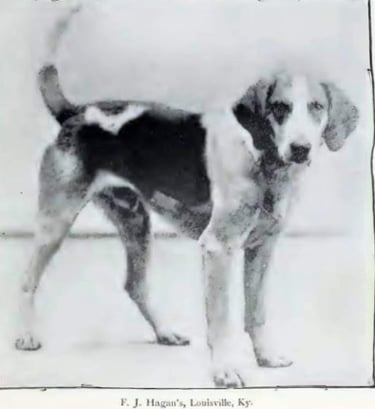
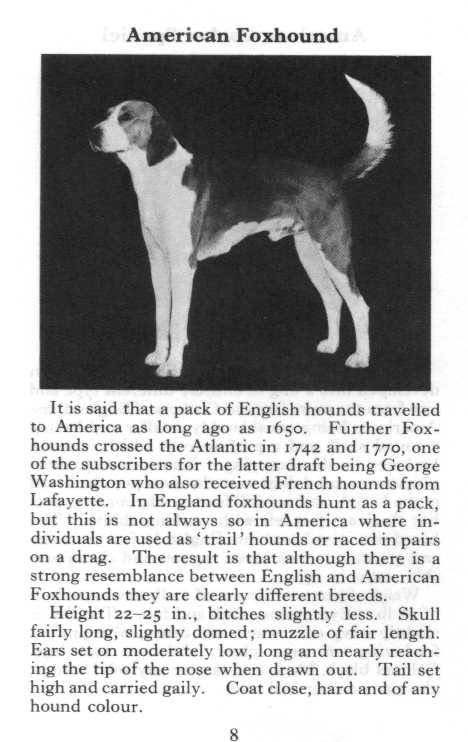
The American Foxhound has physique and characteristics singular to its purpose. Hounds in hard running condition should be given preference over those that are soft or show too much flesh.
HEAD
Skull: The Skull Should be fairly long with the cranium broad and full, slightly domed at occipital area adjoining the neck.
Defects: A very flat skull; narrow across the top; excess of dome.
Ears: Ears set on moderately low, long, reaching when drawn out nearly to the tip of the nose; fine in texture; fairly broad; with almost entire absence of erectile power; setting close to the head with the forward edge turning in slightly toward the cheek; round at tip.
Defects: Ears short; set on high, or with tendency to rise above the point of origin.
Eyes: Eyes large, set well apart; soft and hound-like; expression gentle and pleading; any color.
Defects: Eyes sharp and terrier-like or prominent and protruding.
Muzzle: Muzzle of fair length; straight and square cut; the stop moderately defined.
Defects: Muzzle long and snipey; cut away decidedly below the eyes, or very short; parrot mouth or undershot mouth; Roman nosed, or upturned giving a dishface.
BODY
Neck and Throat: Neck of medium length rising free and light from the shoulders, strong in substance yet not loaded. The throat clean and free from folds of skin.
Defects: A thick, short, cloddy neck carried on a line with the top of the shoulder. Throat showing dewlap and folds of skin to a degree termed "throatiness"
Shoulders, Chest and Ribs: Shoulders sloping; clean, muscular, not heavy or loaded, conveying the image of freedom of action with activity and strength. Chest should be deep for lung space, narrower in proportion to depth, 29 inches in a 23 inch hound being good. Well sprung ribs; back ribs should extend well back; a three-inch flank allowing springiness.
Defects: Straight, upright shoulders; chest disproportionately wide or with lack of depth. Flat ribs.
Back & Loin: Back moderately long, muscular and strong. Loins broad and slightly arched.
Defects: Very long or swayed or roached back. Flat, narrow loins.
FORE-LEGS AND FEET
Fore-Legs: Straight, with fair amount of bone. Pasterns short and straight.
Defects: Out at elbow. Knees knuckled over forward, or bent backward. Fore-legs crooked.
Feet: Fox-like, pad full and hard. Well arched toes; strong nails.
Defects: Feet long, open or spreading.
HIPS, THIGHS, HIND LEGS AND FEET
Hips and Thighs: Strong and muscled, giving abundance of propelling power. Stifles strong and well let down. Hocks firm, symmetrical and moderately bent. Feet close and firm.
Defects: Cow hocks or straight hocks. Lack of muscle and propelling power. Open feet. Any male with less than two testicles must be automatically eliminated.
TAIL
Tail: Set moderately high; well developed, strong, carried well, with slight upward curve and with good brush.
Defects: A long tail. Tea pot curve or inclined forward from the root. Rat tail, entire absence of brush. Any hound with a docked tail shall be automatically eliminated.
COAT
Coat: A hard hound coat of medium length.
Defects: A short thin coat or a coat of soft quality.
HEIGHT
Height: It is preferred that dogs not be under 22 or over 26 inches and that bitches not be under 21 or over 25 inches. If a hound is measured, the measurement should be made across the back at the point of the withers, while the hound is standing in a natural position with his feet well under him. A foxhound within the height standard shall be given preference over a hound outside the height standard, if the two are equal in confirmation.
COLOR
Color: Any color.
SCALE OF POINTS
Head
Skull................................................... 5
Ears..................................................... 5
Eyes..................................................... 5
Muzzle............................................... 5
20
Body
Neck................................................... 5
Chest and Shoulders................. 15
Back, Loins and Ribs ............... 15
35
Running Gear
Forelegs........................................... 10
Hips, Thighs and Hind Legs... 10
Feet..................................................... 15
35
Coat and Tail
Coat................................................... 5
Tail..................................................... 5
10
Total - 100
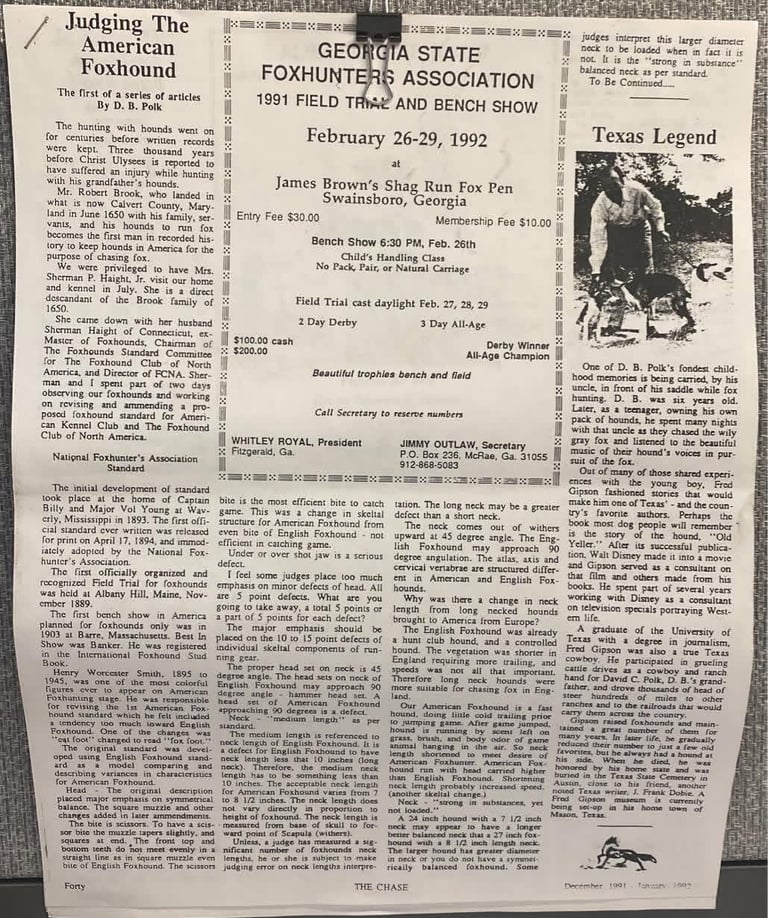
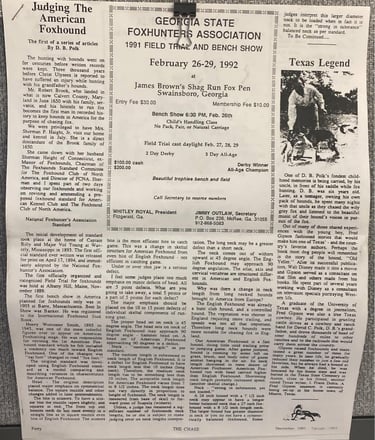
Judging The American Foxhound
The first of a series of articles By D. B. Polk (The Chase, December 1991)
The hunting with hounds went on for centuries before written records were kept. Three thousand years before Christ, Ulysses is reported to have suffered an injury while hunting with his grandfather's hounds.
Mr. Robert Brook, who landed in what is now Calvert County, Maryland in June 1650 with his family, servants, and his hounds to run fox becomes the first man in recorded history to keep hounds in America for the purpose of chasing fox.
We were privileged to have Mrs. Sherman P. Haight, Jr. visit our home and kennel in July. She is a direct descendant of the Brook family of 1650. She came down with her husband, Sherman Haight of Connecticut, ex-Master of Foxhounds, Chairman of The Foxhounds Standard Committee for The Foxhound Club of North America, and Director of FCNA. Sherman and I spent part of two days observing our foxhounds and working on revising and amending a proposed foxhound standard for the American Kennel Club and the Foxhound Club of North America.
The initial development of the standard took place at the home of Captain Billy and Major Vol Young at Waverly. Mississippi in 1893. The first official standard ever written was released for print on April 17, 1894, and immediately adopted by the National Foxhunter's Association.
The first officially organized and recognized Field Trial for foxhounds was held at Albany Hill, Maine, in November 1889. The first bench show in America was planned for foxhounds only in 1903 at Barre, Massachusetts. Best In Show was Banker. He was registered in the International Foxhound Stud Book.
Henry Worcester Smith. 1895 to 1945, was one of the most colorful figures ever to appear on the American Foxhunting stage. He was responsible for revising the 1st American Foxhound standard, which he felt included too much of a tendency toward English Foxhound. One of the changes was "cat foot" changed to read "'fox foot." The original standard was developed using the English Foxhound standard as a model, comparing and describing variances in characteristics for American Foxhound.
Head - The original description placed major emphasis on symmetrical balance. The square muzzie and other changes were added in later amendments.
The bite is scissors. To have a scissor bite, the muzzle tapers slightly and squares at the end. The front top and bottom teeth do not meet evenly in a straight line, as in a square muzzle, even bite of the English Foxhound. The scissors bite is the most efficient bite to catch game. This was a change in skeletal structure for the American Foxhound from the even bite of the English Foxhound - not efficient in catching game.
Under or over-shot jaw is a serious defect.
I feel some judges place too much emphasis on minor defects of the head. All are 5-point defects. What are you going to take away, a total of 5 points or a part of 5 points for each defect? The major emphasis should be placed on the 10 to 15-point defects of individual skeletal components of running gear.
The proper head set on neck is 45 degree angle. The head sets on neck of English Foxhound may approach 90 degree angle hammer head set. A head set of an American Foxhound approaching 90 degrees is a defect.
Neck- medium length as per standard.
The medium length is referenced to neck length of English Foxhound. It is a defect for English Foxhound to have neck length less that IO inches (long neck). Therefore, the medium neck length has to be something less than 10 inches. The acceptable neck length
1 for American Foxhound varies from 7 I to 8 1/2 inches. The neck length does not vary directly in proportion to height of foxhound. The neck length is measured from base of skull to forward point of Scapula (withers).
Unless, a judge has measured a significant number of foxhounds neck lengths, he or she is subject to make judging error on neck lengths interpretation. The long neck may be a greater defect than a short neck.
The neck comes out of withers upward at 45 degree angle. The English Foxhound may approach 90 degree angulation. The atlas, axis and cervical vertabrae are structured different in American and English Foxhounds.
Why was there a change in neck length from long necked hounds brought to America from Europe?
The English Foxhound was already a hunt club hound, and a controlled hound. The vegetation was shorter in England requiring more trailing and speed was not all that important. Therefore long neck hounds were more suitable for chasing fox in England.
Our American Foxhound is a fast hound, doing little cold trailing prior to jumping game. After game jumped. hound is running by scent left in grass, brush, and body odor of game anumal hanging in the air. So neck length shortened to meet desire of American Foxhunter. American Foxhound run with head carried higher than English Foxhound. Shortening nock length probably increased speed (another skeltal change.)
Neck - "strong in substances, yet not loaded."
A 24 inch hound with a 7 1/2 inch neck may appear to have a longer better balanced neck that a 27 inch foxhound with a 8 1/2 inch length neck The larger hound has greater diameter in neck or you do not have a symmet-ricaily balanced foxhound. Some judges interpret this larger diameter neck to be loaded when in fact it is not It is the "strong in subsiance" balanced neck as per standard.
To Be Continued....
The First Show Hounds
Mr. Walker's sons, Mr. W. S. Walker and Mr. E. H. Walker, imported Strive and two bitches from the Duke of Eglinton's pack in Scotland, (these were English dogs though coming from Scotland), and crossed them upon the Walker hound, producing the noted Big Strive, Pearl Strive, and any other splendid hounds. These hounds were bigger, finer looking hounds and an improvement over walker hounds of that time. Ch. Big Strive and Pearl Strive, won everywhere whenever shown on the bench. Big Strive was a first class fox hound with good bottom, but lacked gameness to a certain extent It was the same here as with the earlier English crosses, outside of conformation and color, the drive as fox hounds, were inferior to the Walker hounds. Many of the best hunters prefer a pedigree without the cross on Strive and Clara for hunting.
From The Chase Magazine, July 1923